
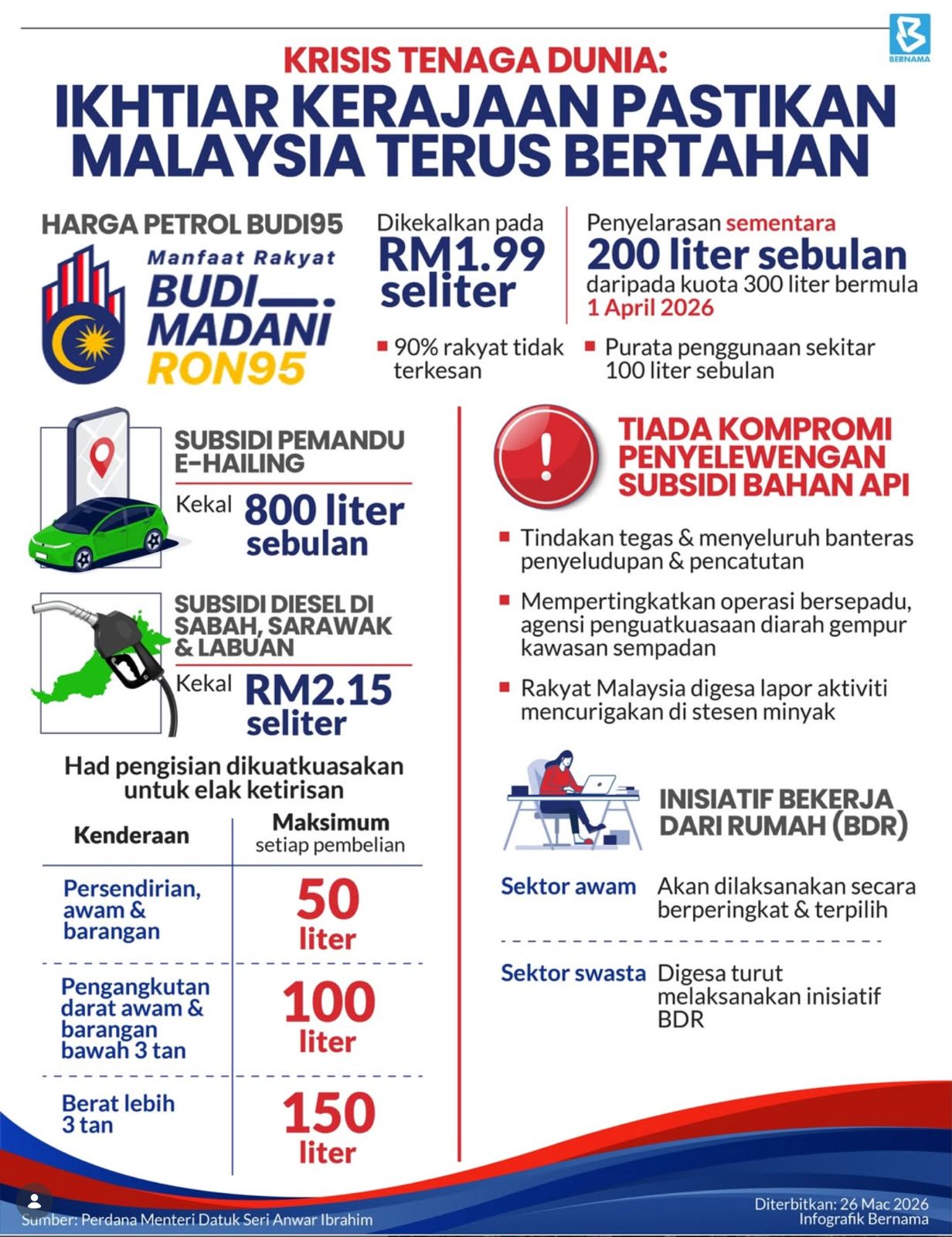
Yesterday, PMX announced several national preparedness measures to deal with the global energy crisis. Put simply, the aim is to make sure we have enough fuel for domestic use. Among the measures: the Budi95 subsidy goes from 300 litres down to 200 litres, and civil servants will Work From Home (WFH) in stages and on a selected basis. The private sector is also being urged to implement WFH.
This is the reality I shared on the Double Ace Podcast with Dato’ AC Mizal last Tuesday. We covered a lot, and one of the things I raised was for the government to look at home-based teaching and learning (PdPR) for our children.
Start with civil servants immediately, then extend it to the private sector as well. I’m confident this will help cut down movement and fuel consumption even further.
All of this has to be considered so we can hold out longer. These are short-term measures, but we still need to do them. And it’s not impossible — what’s happening in other countries can happen here too.
We may still be in Raya mood. Still busy with open houses, visiting family, in an atmosphere that’s supposed to be joyful and calm. But behind all of that, there’s a crisis whose effects many people haven’t seen yet.
But for those who understand economics and business, this is no small matter. It’s something all of us should be worried about — and act on.
Some entrepreneurs think the wars and conflicts happening far away from Malaysia won’t affect their business at all. But don’t forget, the world today is interconnected.
What happens overseas affects oil prices, logistics costs, raw material supply, currency values and the price of goods.
And eventually, that effect reaches your business.
When oil prices go up, delivery, shipping and supplier costs all go up. When every cost rises, your overall business operating cost rises too.
There’s one important thing we need to understand. In economics, one small change can trigger a big effect.
That’s what’s happening now, and this is just the beginning. If this crisis drags on, these are some of the realities we’ll have to face:
- Costs will keep going up. Some businesses have already received notices from factories about cost increases of up to 30%.
- Customers will be more careful. When the economy is unstable, people start saving, cut back on purchases and focus only on necessities. “Nice to have” products get hit first.
- Margins will be squeezed. When costs go up but sales don’t, what happens? Profit gets thinner, and some start making losses.
And the most dangerous part is when a business looks alive, but is actually dying slowly!
That’s why I say in business, you need a backup plan. If things don’t run smoothly, what’s your plan B, C and so on?
The problem with many entrepreneurs today is they only have Plan A and won’t prepare early. When the crisis gets worse, they panic and act too late. And in business, acting late means losing money!
Don’t wait until your cash flow dries up before you act.
Before this, our focus was probably to grow, expand and scale to a higher level. But in the crisis I’m seeing right now, entrepreneurs need to shift to optimize, stabilize and strengthen.
Crisis never waits for us to be ready. But we can choose to be ready before it forces us to change!
Datuk Wira Dr. Azizan Osman,
Mentor to Millionaire Entrepreneurs
Crisis never waits for us to be ready. But we can choose to be ready before it forces us to change!
Prof. Datuk Wira Dr. Azizan Osman
Business growth strategist, mentor and TV & podcast host – guiding founders and MSMEs through expansion and scale.